

Designing Against Deception: Darija Medić’s Work on Ethical User Experience
Darija Medić's work is focused on identifying obstacles to equitable user experience design in the ever-evolving landscape of tech development.
Megan Briggs Pintel | College of Arts & Media Apr 15, 2026
Have you ever found yourself scrolling on social media far longer than you intended to and then felt ashamed for not being able to pull yourself away?
Darija Medić, Assistant Professor of digital design in CU Denver’s College of Arts & Media, is imagining a future where designers don’t create platforms to do that. Instead, they prioritize users' wellbeing and autonomy over profit-driven optimization.
Big Tech and Dark Pattern Design
When an app makes you feel “othered” or pressured into doing something you wouldn’t have done on your own, that is known as deceptive or dark pattern design, and this manipulative practice affects us more often than we realize.

The goal of deceptive design is to exploit “unconscious decision-making patterns” that have been well-researched in fields like behavioral economy with the goal of capturing user attention, money and data. One study found that among 240 popular phone apps, 95 percent of them contained at least one type of dark pattern. Another study examined large language models (LLMs) being used to generate website user interface (UI) design; the resulting interfaces had deceptive design patterns automatically present within them.
Your average iPhone and Android user isn’t aware of their cognitive biases being exploited and runs into these dark design patterns daily. Sometimes these patterns are subtle and almost imperceptible (like the infinite scroll function on social media platforms), but other times they go so far as to mimic toxic human behavior by using patronizing, shaming, and emotional blackmail language, which Medić refers to as toxic personalization. “Such a practice is ultimately the antithesis of ethical and accessible design, and my work focuses on showing how these types of manipulation happen and how they can affect different users,” Medić says.
For instance, the following screenshot shows an automated message sent from the company dbrand, using heavily shaming language to prompt someone to change their mind about unsubscribing from their mailing list.
Art, Activism, Media, and Software Studies Merge
Medić’s work is focused on identifying obstacles to equitable user experience design in the ever-evolving landscape of tech development. Medić’s ultimate goal is to establish a better understanding of what designing consentful interfaces today and in the future would require.
Originally from Serbia, Medić’s background spans art, activism, media and software studies, and web design and development. She has shown work internationally at over 70 venues; cofounded and run a civil society organization focused on the relationship of gender and technology through creating collaborative learning platforms; and curated and produced an exhibition for the Internet Governance Forum at the UN in Geneva, among other things.
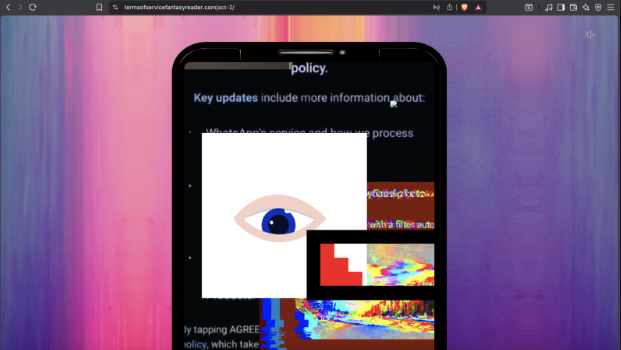
Over the past several years she has conducted public participatory performances in which she provides participants a designated space and time for dramatizing the Terms of Service agreements of various apps in use on people’s personal devices, focusing on the least clear, misleading or strange language found. As each person participating in the performance enacts their chosen segments, the contributions are recorded and included in a growing interactive online archive and web drama, accompanied by screenshots of suggestive app notifications. This project is called The Terms of Service Fantasy Reader.
Računari 144: Revisiting an Influential Piece of Culture
Medić is currently developing a publication, a new fictional issue of the computer magazine Računari, which was active from 1984-1999 in former Yugoslavia and was known internationally for building and fostering a progressive DIY computing culture, as well as for its overtly sexualized female cover imagery. This is part of her larger project Računari 144, which “uncovers how Računari magazine shaped notions around computer users and technical expertise within a socialist interface culture that developed outside Western centers of the computing industry.”
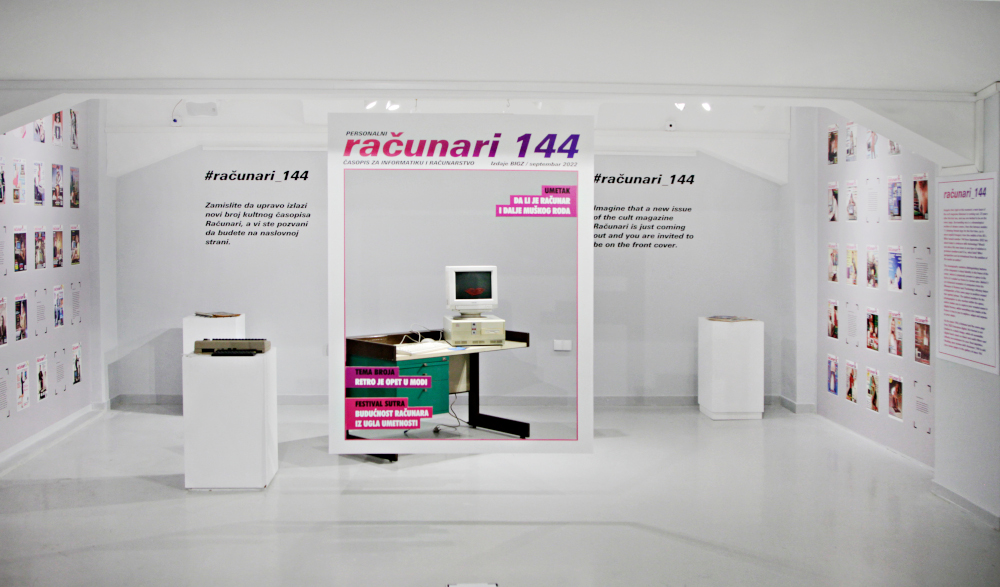
Računari 144 was converted into an interactive display at the Museum of Science and Technology in Belgrade, Serbia, in 2022. Visitors were invited to physically enter the frame of the magazine and re-stage its covers, giving them the opportunity to reimagine our collective relationship to computing and power in society. The display was expanded in 2025 into a solo exhibition at the Cultural Center of Belgrade’s Main Gallery, within which visitors could also rewrite the cover captions and explore video interviews with some of the former cover models and women involved in computer culture in former Yugoslavia and Serbia. The publication Medić is developing gathers these artifacts together with examples of contemporary communal alternatives to big tech computing as one possible speculative edition of a contemporary Računari magazine.
Teaching Future Designers at CU Denver
Now in her second year at the College of Arts & Media at CU Denver, Medić teaches her digital design students to think about the broader context and impact of their work so that they can intentionally design in the service of their end users.
CU Denver and the Auraria campus attracted Medić because of its urban setting with a diverse student population and its large pool of nontraditional students — something that is rare in design schools or in the design profession generally. “We cannot make design more equitable if the field is homogenous and gatekept by privilege,” Medić explains. “It makes me especially excited to support nontraditional student populations in entering the design field so they can bring their lived expertise into the work that they do,” she says.