

What Can You Do with an Illustration Degree?
“Solving problems visually” is how artist and Illustration program director Charles Valsechi describes the diverse field of professional illustration.
Megan Briggs Pintel | College of Arts & Media Oct 8, 2025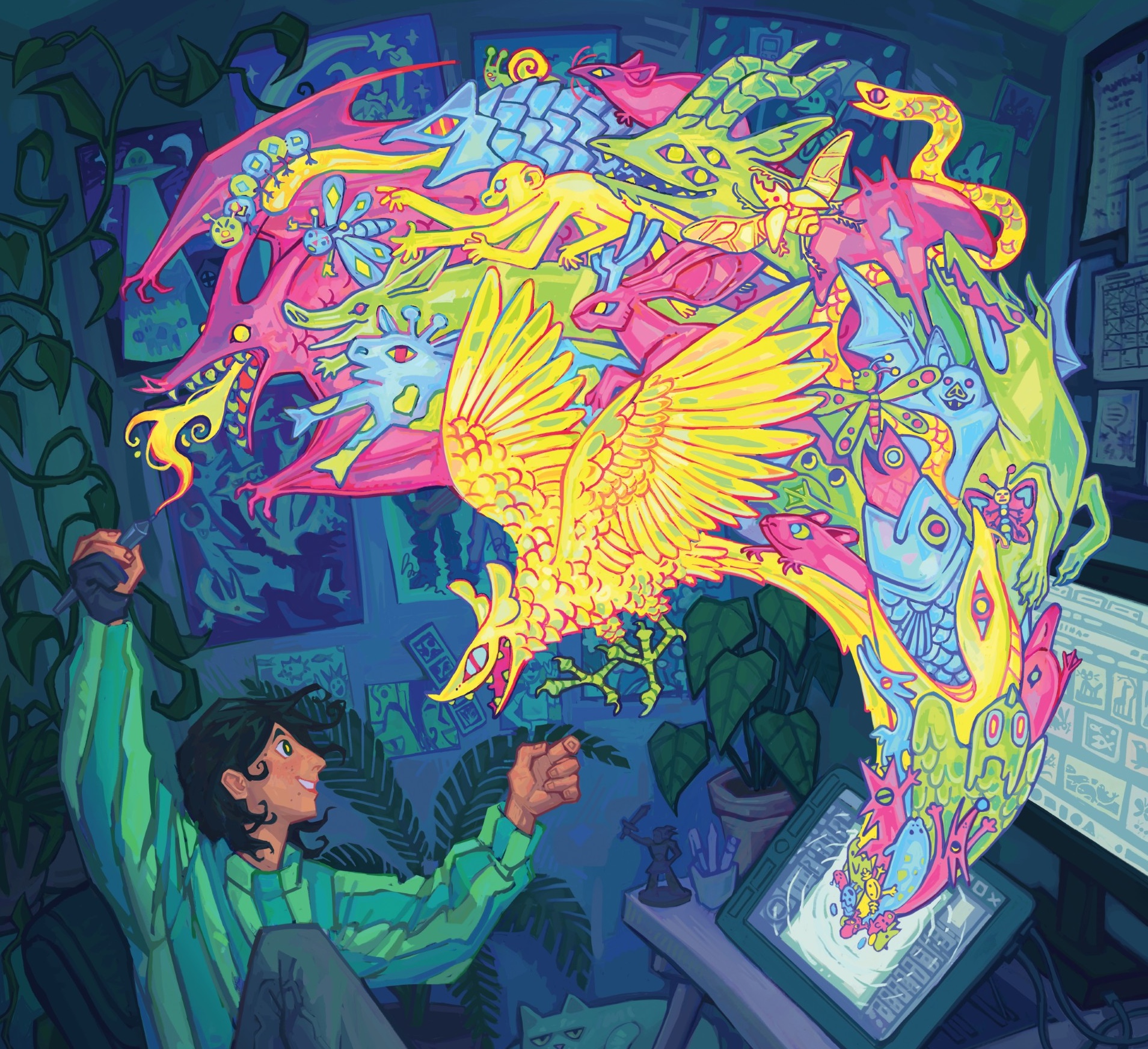
ILL Exhibition Fall 2025
Oct. 9-19
CU Denver Experience Gallery
Juried by Natalie Andrewson, featuring
the work of CU Denver Illustration students
Opening reception: October 9, 2025 | 4:00-6:00 pm
Illustration spans a wide range of applications and industries—everything from children’s books to advertising to aerospace to medicine. At CU Denver, Illustration students learn not only how to hone their craft, but also how to get started down the various career paths a degree in illustration affords.
“Solving problems visually” is how Assistant Teaching Professor and Illustration Program Director Charles Valsechi describes the profession.
Many students come into Illustration at CU Denver wanting to create comic books or graphic novels, two things that unfortunately don’t have strong demand in today’s job market. Valsechi does his best to steer students toward roles that are in demand and overlap with their original aspirations. “Art is a challenging space, so I want them to be aware of the different options that might relate to what they’re interested in,” he explains. One example is storyboarding, an in-demand role for marketing and advertising agencies, film and television studios, and gaming companies, and which is similar to graphic novel and comic book creation.
The Advantage of Getting an Art Degree at a Public University
Recently, Animation Career Review named CU Denver among the top 25 public illustration schools in the U.S. With a degree map featuring classes that build on themselves, CU Denver’s Illustration program gives students a strong foundation. Students receive instruction in conceptual illustration, digital illustration, rendering, perspective, painting, exhibition preparation, market research, professional practices, and both traditional hands-on and digital illustration techniques. The classes are taught by faculty members whose professional backgrounds are diverse. Among them, a children’s book illustrator, a digital fine artist, and a medical illustrator.
With only two illustration degree programs in Colorado, CU Denver has the advantage of offering a host of other classes and degree fields. Valsechi points to the perks of teaching students at a public institution, namely the more accessible tuition rates and the resources available to students. Facilities in CU Denver’s College of Arts & Media (CAM) include state-of-the art digital labs, two art galleries, industrial equipment, and sculpture studios, as well as CU Denver internship and study abroad programs. CAM’s digital animation center (DAC) trains students in 3D Graphics & Animation, yet many Illustration students find their way into the DAC as well to pick up 3D skills. Many students choose to pair their BFA in Illustration with minors from other departments or colleges.
Students benefit from opportunities to show their work throughout their course of study. The annual “ILL” exhibition at CU Denver’s Experience Gallery, located in the Denver Performing Arts Complex, puts student work in a high-traffic area just off campus. This year’s exhibition was juried by professional illustrator Natalie Andrewson and will be on display Oct. 9 – 19, 2025. Andrewson will also be conducting portfolio reviews during her visit—a valuable experience for students to get feedback from a working professional.
Last year, CU Denver students’ artwork was featured in Westword’s annual Best of Denver edition. Illustration students are also regularly chosen to display their work in CAM’s annual juried student show, “Guilty”, held at CU Denver’s Emmanuel Art Gallery. During their last year of study, Illustration students prepare for the BFA thesis show, which takes place just before graduation in May and has previously been held at RedLine Contemporary Arts Center in Denver.
Illustration Affords Many Opportunities
Given the vast array of professional opportunities, today’s illustrators must understand how to communicate effectively with a chosen medium and situate their work professionally within a particular market.
Valsechi’s own career has had many plot twists. Originally interested in game programming, his education started at a community college where he took art and computer programming classes. He finished a bachelor’s degree at Ringling College of Art & Design, shifting his focus to illustration and fine art. From there, his career has encompassed painting and selling fine art, storyboarding for gaming companies, creating illustrations for a podcast, and advertising work for large companies like Mini Cooper. His skills have taken him across the U.S. and even overseas—at one point he was working for an electronics company in Germany. He’s even started a gaming company with friends he's met in the profession. In 2022, Valsechi co-founded the Solarpunk Conference, a remote multidisciplinary conference with a focus on visions of a green, equitable future. One thing has remained constant on his CV, though: teaching. Starting in his undergrad days, Valsechi has taught students just barely younger than himself to students much older how to draw, paint, and illustrate.
Whichever industry they choose to work in, Valsechi tells his students they will be working on “anything an illustrator can bring to life.”