

The Tivoli Underground: CU Denver’s New Contemporary Music Venue Doubles as Stage and Classroom
By equipping a contemporary performance venue, CU Denver’s Music & Entertainment Industry Studies department is crafting valuable learning experiences and facilitating community building that will help students in their careers.
Megan Briggs Pintel | College of Arts & Media Oct 6, 2025
CU Denver’s College of Arts & Media (CAM) has opened a new contemporary music venue on the Auraria campus in downtown Denver. The Tivoli Underground was christened in August with a back-to-school concert featuring a student band and has more concerts lined up for the remainder of the semester.
It’s the best looking and sounding space on campus,” says Kevin Lee, a lecturer and recording and live sound engineer in CAM’s Music & Entertainment Industry Studies (MEIS) department.
A Contemporary Space for Contemporary Music
Located in the basement of the Auraria campus’s historic Tivoli building, MEIS will use the Tivoli Underground to host concerts and classes. In speakeasy fashion, the subterranean space has an intimate, cozy feel with a capacity of about 170 people. The exposed brick, heavy red velvet curtains, and quirky features like padded benches along the walls give the space character. Over the summer, Lee upgraded the space by having a sound system complete with Allen & Heath SQ-7 audio console and ChamSys lighting system installed.
The Tivoli Underground contributes to MEIS’s mission to prepare students for a career in the music industry. Not only will it provide aspiring touring musicians and singer/songwriters a place to rehearse and perform, but it will also afford experiential learning opportunities for students interested in the business and technical sides of music—things like artist management, marketing, venue management, production, live sound, and lighting. Eventually, the student organization MISA (Music Industry Student Association) will handle all the logistics of booking performers, front of house management, and marketing the space and its shows. Lee’s goal for the live sound students is that after 3- or 4-years’ experience in the Tivoli Underground, they will feel confident working gigs at other live music venues of similar size.
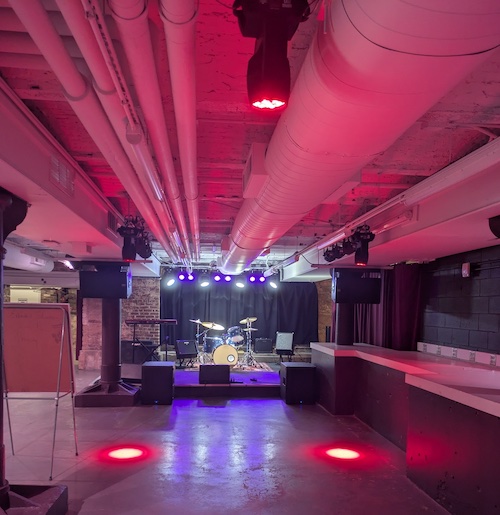
Before the Tivoli Underground, students looking to perform with sound equipment on campus were limited to options in King Center, the atmosphere of which lends itself more to classical music. As MEIS chair and Senior Instructor Evan Shelton summarizes, the Tivoli Underground is a contemporary space for contemporary music, and its contemporary nature aligns with the curriculum offerings of the college.
Music Business student Katie Overbey and her band, the Backlash, performed a welcoming concert in August. Overbey has played at a handful of venues in the Denver metro area and out of state and says the Tivoli Underground feels “considerably more professional” than a lot of other venues. Having been classically trained in violin, Overbey says the mentorship she’s received from Shelton and her fiddle instructor, Enion Pelta, in particular has been inspiring. The Backlash’s music fits a handful of genres, including rock, punk, and even folk, and Overbey has found ways to incorporate her violin and switches between guitar and violin while performing with the band. At other venues, the logistics of this can be tricky, but she says the Tivoli Underground is equipped for such maneuvers.
CU Denver’s Music Students Form Strong Bonds with Faculty and Peers
In MEIS, students learn from faculty with diverse career paths. “One of the benefits of our program is that there is a vast wealth of knowledge represented by our faculty and the diverse career paths they’ve taken,” explains Shelton. Shelton himself is a classically trained cellist with a master’s degree in the Suzuki method. He’s also played bass guitar in a rock band. He knew from a young age that no matter what he did professionally, he wanted it to involve music.
A lot of MEIS students feel the same way. Even if they play an instrument or write songs, many of them also study the business or technical side of the music industry through classes like music venue management, live sound, or audio post production. And since the college offers both audition-track and non-audition track degrees, other MEIS students don’t play an instrument or sing.
Students in MEIS form strong bonds with the faculty members and their peers, often running into each other professionally after leaving CU Denver. Shelton recently played a gig, for instance, where the sound engineer was one of his former students. “The music industry is smaller than people think. So, the more we can put students in situations where they are collaborating and hanging out in venues like this, the more we help them build that network,” Shelton says.
Overbey confirms that aspiring musicians should be seeking collaboration, and they will find it at CU Denver like she did. The Backlash came together when she met her fellow bandmates Emerson Vaughn (lead guitar), Gabby Trownsell (bass guitar), and Jett Barone (drums) in class.
Lee can vouch for the networking opportunities the music department affords, having graduated from CU Denver and studied in MEIS himself. “If you come to school here to study music, you will get plugged into gigs,” Lee says.
That’s exactly the idea behind the Tivoli Underground. It’s a place where students can connect, work together, and perform, while inviting the Auraria campus community to experience good, live music. With its central location and proximity to CU Denver’s City Heights Residence Hall, faculty and students alike hope it blossoms into a welcoming and lively place.